Some cities can be summed up in a single sentence, and that’s enough. Aalborg isn’t one of them. To understand it, you have to look at it as three cities layered on top of each other in the same place: a Viking trading crossroads, a nineteenth century industrial powerhouse, and finally, a modern city of universities, music, and a carnival that explodes into color every May. All three versions of Aalborg still live side by side, on the banks of the Limfjord, at the point where the water is narrowest, and where, for centuries, everything had to pass through.
On the Banks of the Limfjord
Aalborg sits at the narrowest point of the Limfjord, a long sea channel that connects the North Sea to the Kattegat and splits Jutland in two. That geographic narrowing wasn’t a coincidence, it’s the reason the city exists at all. Anyone who needed to cross from one shore to the other, to move goods, an army, or livestock across northern Denmark, had to pass right through here.
Around the year 700, a large Viking settlement developed here at what is now Lindholm Høje, a precursor to today’s city, and the first written mention of the city’s name, recorded then as “Alabu,” appears around 1040, on a coin minted for King Harthacnut. The name itself is poetic: it derives from an old Nordic term meaning roughly “river of swans.” A city born as a crossing over water, named after the birds that inhabit that water, it’s hard to imagine a more fitting beginning.
Stone Circles on a Windswept Hill
North of the center, across the fjord, on a windy hillside, lies one of Scandinavia’s most striking archaeological sites, Lindholm Høje. This Viking burial ground, more than a thousand years old, contains hundreds of graves marked by stones arranged in the shape of ships or circles, scattered across the entire hill. Ironically, the very thing that preserved the cemetery is also the reason it vanished from memory for centuries: forest clearing triggered sand drifts that buried the whole hill and kept it intact, until archaeologists rediscovered it. Today, standing where Viking shipbuilders once buried their dead inside stone outlines of their own ships, the view opens straight onto the fjord, quiet, windswept, and faintly eerie, exactly how a place that remembers a thousand years ought to feel.
The Sunny Side of the Fjord
The site belongs to the town of Nørresundby, which remained separate from Aalborg until 1970 and today is fused to it by two bridges and a tunnel. Though administratively part of the same municipality, it still holds onto its own identity, and its own nickname, “Solsiden,” the Sunny Side, thanks to its position on the fjord’s north bank, facing straight into the sun. The first link to Aalborg was a slow pontoon bridge from 1865, which opened and closed every time a ship passed, until it was replaced by the sturdier Limfjordsbroen in 1933, and then, in 1969, by the Limfjordstunnelen, Denmark’s first ever motorway tunnel.
The Merchants’ Golden Age
Medieval Aalborg was anything but modest. The city officially received its market town charter in 1342 and quickly became one of the most important trading centers in Scandinavia, helped in part by a monopoly on salting herring from the Limfjord, granted in 1516, at a time when salted fish was one of the most valuable export goods in northern Europe.
That wealth is still visible today, quite literally, in stone. Jens Bang, the wealthiest merchant in Denmark of his time, built a five story stone house in the city center in 1624, covered in grotesque ornamentation, a building meant to make unmistakably clear to everyone in the square who held the money here. That house still stands today, with its strange gargoyles, surrounded by cobblestone streets and baroque facades around the Church of Our Lady, a monument to what historians still call the golden age of Aalborg’s merchants.
From Aalborg to the Sydney Opera House
The nineteenth and twentieth centuries brought Aalborg an entirely different scent, the scent of industry. The city became a major exporter of grain, cement, and spirits, with companies like Aalborg Portland growing into global cement producers. Shipyards lined the coast, chimneys pierced the sky, and for decades Aalborg was synonymous with the working class, hard labor, and factory bells.
Out of that very environment, paradoxically, grew one of the world’s most celebrated architects. Jørn Utzon grew up in Aalborg, and it was the local shipyards that inspired many of his architectural forms, including, later, one of the most recognizable roofs in the world, on the Sydney Opera House. The curved lines of ship hulls he watched as a boy on this coast would, decades later, become sails made of concrete on the other side of the planet.
From Heavy Labor to Light Notes
Sometime around 1974, Aalborg began to change its identity. The opening of Aalborg University that year marked a turning point, from heavy industry toward education and technology, and ever since, the city has increasingly resembled a laboratory for reinventing itself. Today, Aalborg University is known for its strong focus on engineering and technology and regularly ranks among Denmark’s leading institutions, and every autumn a wave of students temporarily swells the city’s population.
The old industrial harbor went through a similar transformation. Where shipyards once devoured metal and smoke, the Utzon Center now stands, built right on the Limfjord, its sculptural roofs echoing sails or waves, dedicated to the work of the man who left this very place to conquer the world. Beside it, the House of Music (Musikkens Hus), by the firm Coop Himmelb(l)au, dominates the revitalized waterfront with its complex geometry of concrete and glass, while the former power plant, Nordkraft, is now a cultural center, an example of how Aalborg layers the new onto the old, instead of erasing one for the other.
If You Don’t Know When to Visit Aalborg, Make It May
A city that otherwise flows calmly makes one exception a year. The Aalborg Carnival, usually held on the last weekend of May, unfolds in three parts: a children’s carnival, a battle of carnival bands, and the main carnival parade, drawing around a hundred thousand visitors and making it the largest carnival in Scandinavia and one of the largest in northern Europe.
What makes the carnival especially dear to the people of Aalborg is how personal it is. About seventy percent of the costumes are handmade by the participants themselves, and the tradition reaches back to the twentieth century, to the first “Karussel Race” organized in 1955, inspired by Hamburg’s Hanseatic carnival traditions. Streets that are quiet and orderly the rest of the year turn into a river of color, brass instruments, and costumes every May, as if the city takes off its work clothes once a year and reveals that behind the facade of merchants and engineers, there’s always been an untamed Viking side too.
When the Sun Goes Down, This Street Wakes Up
For anyone looking for Aalborg after midnight, there’s really only one address worth remembering: Jomfru Ane Gade, literally “Virgin Anne’s Street,” one of the most famous streets in Aalborg, if not in all of Denmark. By day, it’s a row of pleasant cafes; by night, it turns into something else entirely, a street packed with clubs, discos, and bars that gets livelier the later it gets. The street once had a darker reputation too, in the nineties it was known as a gathering spot for two motorcycle clubs that were locked in conflict across Scandinavia for years, but those days are long behind it, and today it’s a place where students, tourists, and locals mix freely, with no trace of that old legacy of violence left to speak of.
What to See
For all three versions of Aalborg we’ve just traced through history, there’s still a tangible, visitable trace today, dense enough that a proper visit is worth setting aside at least two to three days.
Lindholm Høje (nordmus.dk) remains the starting point for anyone wanting to feel the Viking side of the city, with hundreds of stone grave markers and an accompanying museum. It’s actually visible from the plane on landing, that’s how distinctive its shape is.
Aalborg Zoo (aalborgzoo.dk), open since 1935, is today the city’s most visited attraction, home to more than a hundred species of exotic animals, including rare Siberian tigers and a polar bear family you can follow live on webcam.
KUNSTEN Museum of Modern Art (kunsten.dk) hides a surprise few people expect: it’s the only building outside Finland designed by Alvar Aalto. The white marble exterior and a skylight system engineered to track the arc of the northern sun make the architecture itself just as worth seeing as the nearly four thousand works inside.
Utzon Center (utzoncenter.dk), the House of Music (musikkenshus.dk), and Springeren, the maritime experience center (with a real, decommissioned submarine docked along the quay), round out the story of a city that treats architecture as serious art.
For a taste of the old merchant town, it’s enough to wander through Hjelmerstald, a network of cobblestone lanes, pause in front of Jens Bang’s stone house and Budolfi Cathedral, then climb Aalborgtårnet (aalborgtaarnet.dk), with its view over the entire city and the fjord below.
All Eras, at Once
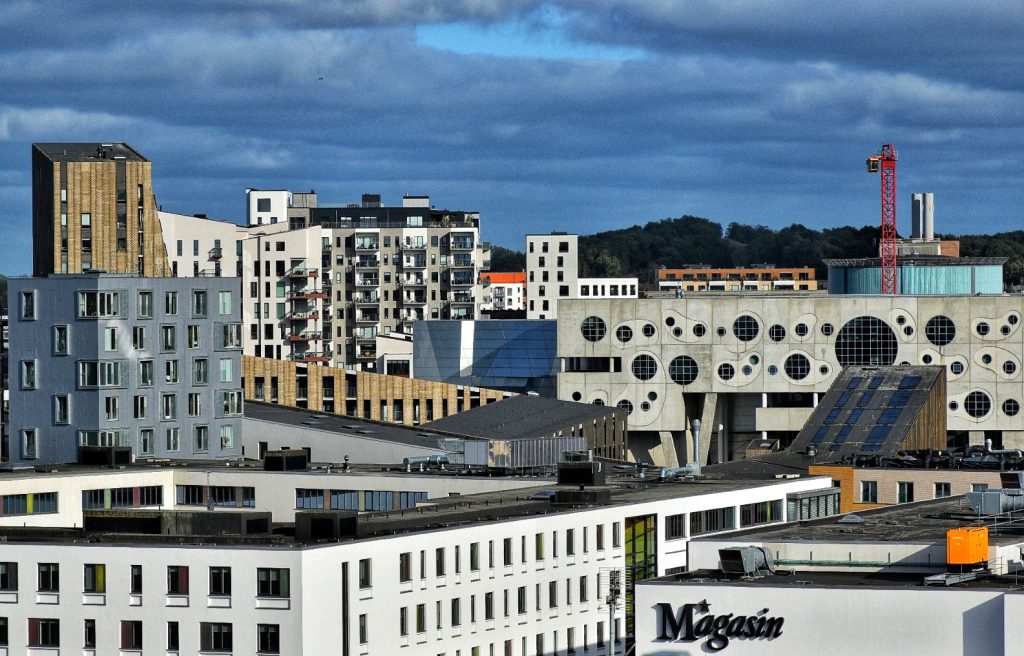
Aalborg remains one of Denmark’s larger cities today, the city itself the fourth largest by population, and the municipality the third most populous in the country. But numbers were never its strongest card. Its real strength lies in the fact that it never erased any of its previous versions to become this new one. The Viking graves still stand on the hill above the fjord. Merchant Jens Bang’s house still looks out over the square. The old chimneys were turned into cultural centers, not torn down to their foundations. The university brought youth, but it never erased the city’s working class soul.
Maybe that’s the real lesson Aalborg offers anyone who visits with attention: cities don’t have to choose between their past and their future. Like the Limfjord that surrounds them, they can simply flow, slow, steady, patient enough to carry all their eras at once, until one May weekend, when they decide, if only for three days, to let all those eras dance through the streets together.