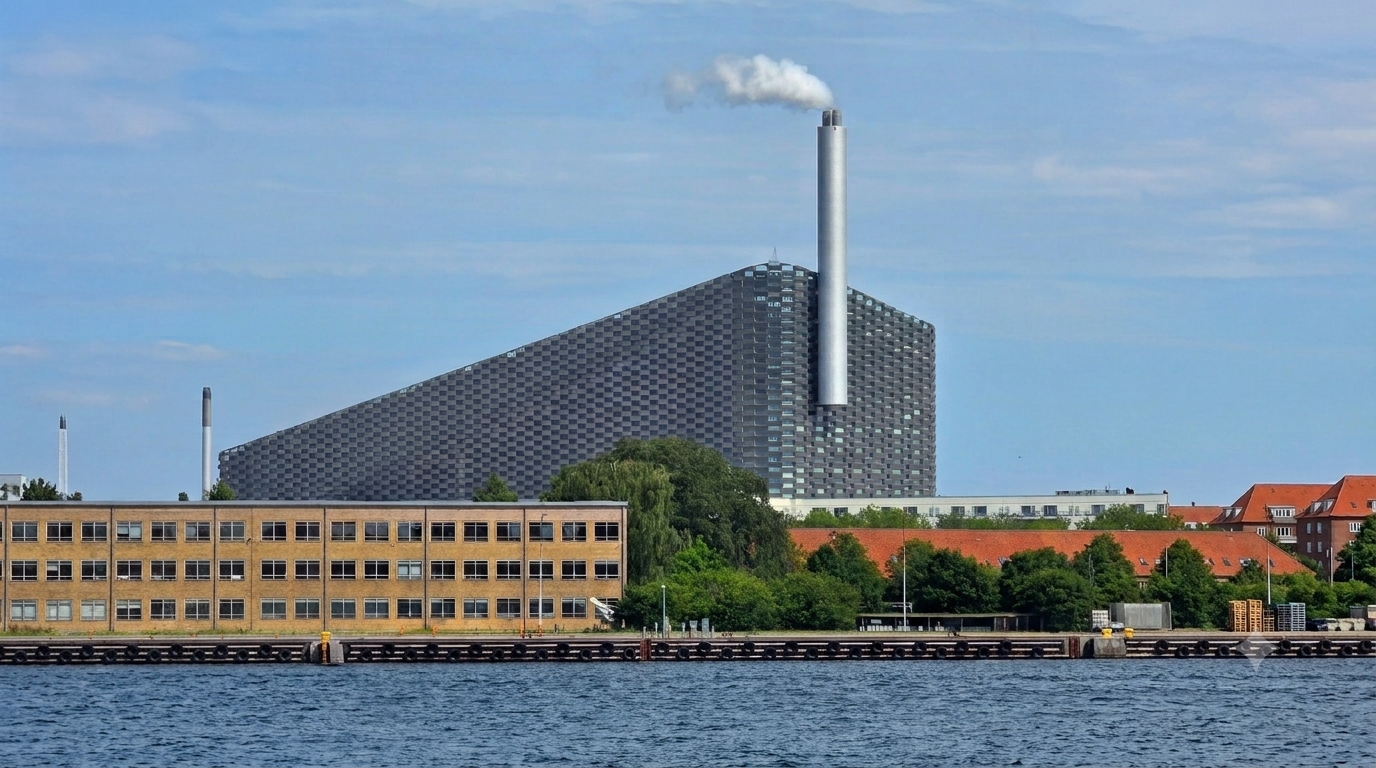
If someone asked you to picture a waste incineration plant, you’d probably imagine something gray, ugly, and tucked away on the edge of a city, a place you drive past quickly without a second look. Copenhagen decided to do the opposite. Instead of hiding the plant, they turned it into one of the most photographed buildings in the city, complete with a ski slope on the roof, a climbing wall on the facade, and a walking trail that winds all the way to the top. It’s called CopenHill, also known as Amager Bakke, and it is, quite literally, a mountain that Copenhagen built because it doesn’t have a real one.
It’s hard to imagine a greener ski slope than this
Denmark is one of the flattest countries in Europe. The nearest proper alpine skiing destination is a six hour drive away, in Sweden. When the studio BIG (Bjarke Ingels Group) won the competition in 2011 to replace an aging, fifty year old waste incineration plant in the Amager district, founder Bjarke Ingels asked a question that sounded almost absurd: why couldn’t a power plant have a ski slope on its roof? By his own account, part of the idea came from the water skiing clubs that were based in the nearby docks at the time. If the water around the plant was already a place for recreation, why not the roof itself.
The name “Amager Bakke” literally means “Amager Hill” in Danish. Bakke is the Danish word for hill, an honest, unassuming preview of what the building was about to become.
Serious technology, playful fun
CopenHill isn’t just a ski slope sitting on top of a factory. First and foremost, it’s a serious piece of industrial infrastructure. The plant converts 440,000 tons of waste per year into clean energy, providing heat to around 60,000 households and electricity to another 30,000, making it one of the most efficient and environmentally responsible facilities of its kind in Europe.
What makes the building unusual is that BIG didn’t try to hide that industrial function. They did the opposite, putting it on full display. The building takes the shape of a sloped wedge, wrapped in a facade of massive aluminum “bricks,” each 3.3 meters long and 1.2 meters tall, stacked to resemble an ordinary brick wall blown up to an absurd scale. The chimney, instead of quietly releasing steam, was designed to occasionally puff out smoke rings, a visual reminder to residents every time the plant emits a ton of carbon dioxide. An unusual mix of technology and public climate education.
Skiing without snow, climbing without a mountain
At the top, on the sloped green roof, a 9,000 square meter artificial ski slope stretches out, covered in a special plastic surface that requires no snow, no artificial freezing, and no water. It can be used year round, regardless of the weather. Alongside the ski and snowboard slope, there are climbing lifts, a slalom course, and a 490 meter walking and running trail that takes visitors to one of the highest points in all of Copenhagen, without ever having to leave the city.
The building’s facade also features an artificial climbing wall, described by some sources as the tallest in Europe, and by others as the tallest in the world. The exact title depends on the source, but either way, it’s one of the most impressive climbing walls ever built. At the base of the building, visitors will also find a cafe with panoramic views, cable wakeboarding, and even a go kart track, a combination that makes CopenHill feel more like an urban amusement park than an industrial facility.
The philosophy behind it all
Ingels calls this combination “hedonistic sustainability,” the idea that protecting the environment doesn’t have to mean sacrifice or restraint, but can instead be fun, desirable, and part of everyday city life. Rather than tucking the waste plant somewhere out of sight, Copenhagen turned it into a destination people actively choose to visit, weaving industrial infrastructure directly into the social and recreational life of the city.
The building hasn’t been without criticism. Construction costs significantly exceeded the original budget, and the plant’s capacity turned out to be so large that waste had to be imported from abroad to keep it running at full scale, sparking further debate about how sustainable the whole concept really is. Still, as an architectural and symbolic gesture, CopenHill remains one of a kind, a type of building that, as far as anyone knows, never existed before, and may never be built quite the same way again.
Next time you drive past an ordinary factory or power plant, it’s hard not to wonder: what if that one had a mountain on its roof too?
Plan Your Visit
- Name: CopenHill (Amager Bakke)
- Location: Amager, Copenhagen, Denmark
- Website: copenhill.dk
- Instagram: @copenhilldk
- Facebook: facebook.com/Copenhill