Once upon a time, in a small yellow house on the corner of Hans Jensens Stræde, there was a boy who had almost nothing. Except, as it later turned out, the one thing that mattered most. This isn’t the opening of a fairy tale. It’s the start of a real life, one that would go on to fill bookshelves worldwide with stories of mermaids, ducklings, and princesses who feel a pea through twenty mattresses. The city is called Odense, on the island of Funen, and the boy’s name was Hans Christian Andersen.
A Childhood Between Colorful Facades and a Gray Reality
The year is 1805. A father, a shoemaker by trade but a dreamer at heart, and a mother, a washerwoman who spent her days standing in cold water washing other people’s clothes. That was young Hans’s entire world in his first years. He grew up in the very heart of old Odense, in one of those narrow lanes lined with low, colorful houses that tourists photograph at every turn today: red, yellow, slightly crooked with age, as if they’d stepped straight out of an illustration. It’s hard to know how much of that childhood imagination came from the street itself, and how much from the poverty that followed it, but one thing is certain: a child who grew up looking at those facades, in those narrow passages where every house seemed to hide its own story, rarely stays indifferent to the colors and shapes of the world around him.
The family shared a single room, where they lived, slept, and worked, in one of the poorest quarters of Odense at the time. And yet, in that same room, his father read him stories from “One Thousand and One Nights,” and built him a small puppet theater with his own hands, the first stage on which a world much bigger than their four walls could unfold.
When he was eleven, his father died, and the family sank into even deeper poverty. Some boys, in such circumstances, would have lost all connection to imagination. Hans Christian, it seems, did the opposite. He pulled himself deeper into it, as if it were the one shelter no one could take from him.
Years later, there would be a little girl standing on the corner of a cold street, holding a box of matches no one wanted to buy. Each lit match would turn into a brief, flickering window into a warmer, different world: a roast goose on the table, a warm stove, the arms of a grandmother long lost. Andersen didn’t have to invent that cold. He only had to close his eyes and remember his own childhood.
Before the City Knew Who Was Leaving
What sounds almost ironic today is that Odense, quite honestly, barely noticed young Andersen. He was just another poor boy from just another poor family. At fourteen, convinced that nothing awaited him in his hometown, he packed his modest belongings and traveled alone to Copenhagen, leaving Odense behind as a chapter he considered closed.
He had no idea that, decades later, that same city would become something few hometowns ever become for their most famous resident: a shrine.
In a yard full of white ducks, one chick hatches different from all the rest: too large a beak, gray feathers, a way of walking no one recognizes as its own. The whole yard decides, almost unanimously, that it’s wrong. It will take an entire winter, snow, loneliness, and a lake for it to discover what had always been true: that it was never an ugly duckling, but a swan who had simply spent too long looking into the wrong mirror.
How a City Became Part of His Own Fairy Tale
Today, walking through Odense means literally walking through Andersen’s universe. Sculptures inspired by his characters are scattered across parks, alleys, and squares, each by a different artist, as if the whole city took on the task of continuing to illustrate the stories that its once-overlooked son told the world. On the gable wall of Bangs Boder, near his birthplace, a huge, gently painted portrait looks down at you: the face of a man who once had to leave this very city, only for that same city, much later, to love him back.
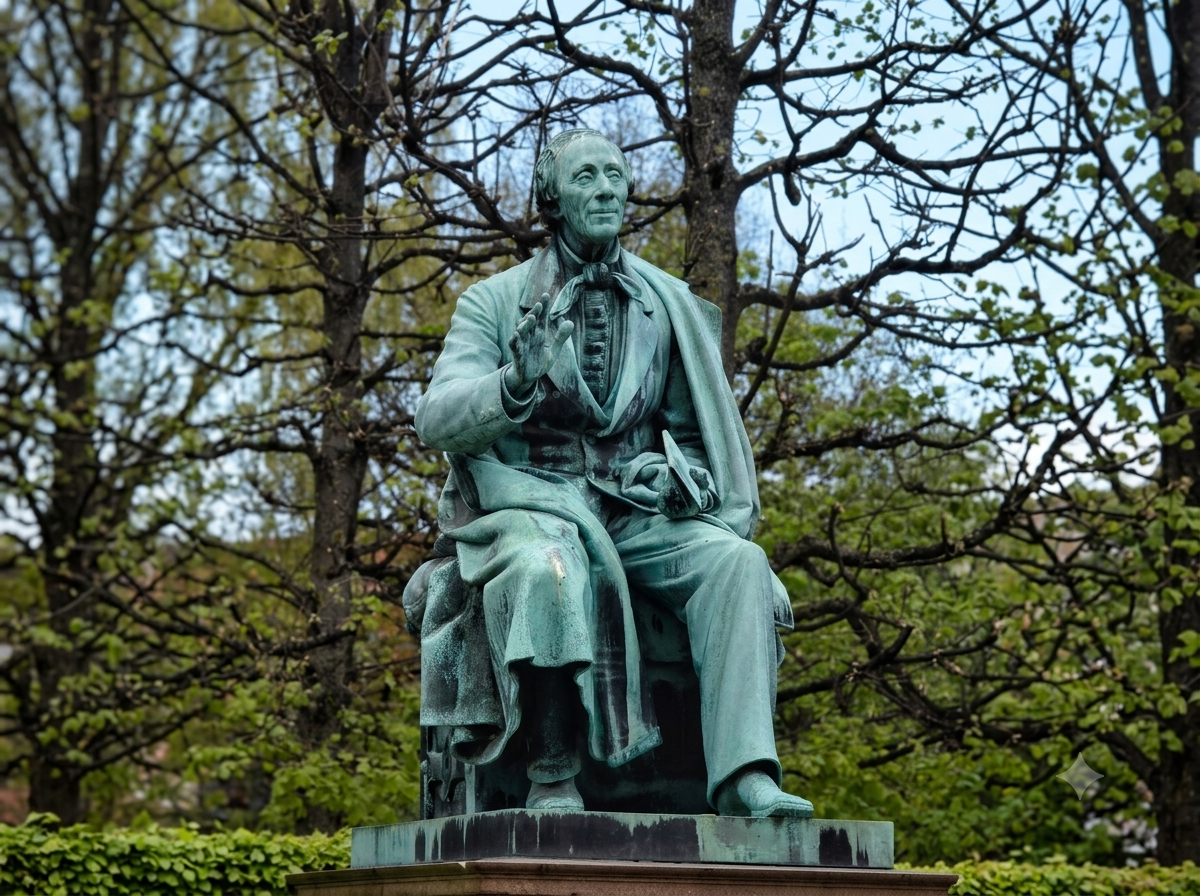
That love also took physical form, in a bronze statue unveiled back in 1888 in the King’s Garden (Kongens Have), which, like some symbolic traveler, moved location twice throughout history: first to Graabrødre Plads in 1905, then, in 1949, to its current spot in the Fairy Tale Garden (Eventyrhaven), where it still stands today, as if waiting for visitors to pay the respect it didn’t always receive in life.
Colorful Houses That Followed Him to Copenhagen, Too
Although he spent most of his adult life far from Odense, in Copenhagen, working his way up as an actor and singer, and later, with the help of his patron Jonas Collin, as a writer, Odense never really left his work. Not even his choice of where to live. Nearly twenty of his seventy years were spent on Nyhavn, a canal whose facades, just like in his native Odense, are painted in a row of different colors, so that no two neighboring houses look the same. In those very houses, across three different addresses, some of his most famous stories were born: “The Tinderbox” and “The Princess and the Pea” at number 20, and “The Little Match Girl” and “The Red Shoes” during his years at number 67, where he spent the longest stretch of time.
The poverty he knew in that small room, the cold his mother endured washing other people’s laundry, the feeling of a child who doesn’t belong: all of it, transformed, runs through his best-known stories. The ugly duckling that no one accepts until it becomes something everyone recognizes as beautiful, the little match girl dreaming of warmth she can only see through glass: these aren’t just fairy tales. They’re echoes of one real, distant Odense winter.
He spent his final years surrounded by a kind of recognition that had once seemed entirely unimaginable: he received honors, traveled across Europe, Asia, and Africa, and turned each journey into a new book. He died on August 4, 1875, in Copenhagen, but his body, as if the city wanted to finally, fully claim him back, rests buried at Assistens Cemetery, while his spirit, it seems, never really left the streets of Odense.
Deep beneath the surface of the sea, a young mermaid looked up toward the light rippling through the waves, and wished for something no one in her world had ever wished for before: legs instead of a tail, silence instead of a voice, just to walk once, only once, on the sand of a world she never truly belonged to, deep down. Andersen, it seems, spent his whole life walking that same, painful step: between two worlds, never fully in either one.
A Few Steps from the House Where It All Began, the Imagination Comes Alive Today
In 2021, Odense opened something few cities manage to build for their writer: not an ordinary museum with display cases and plaques, but an entire world. H.C. Andersens Hus, designed by Japanese architect Kengo Kuma, spans 5,600 square meters, two-thirds of which sits underground, as if the architecture itself had been borrowed from one of his stories, where a whole hidden world lies beneath a tree’s roots (“The Tinderbox” was, not by accident, one of the inspirations behind the design).
The museum is surrounded by a maze-like garden that also serves as a public park for Odense residents, while inside, the original, modest yellow house where Andersen was born connects to modern, circular, almost dreamlike exhibition spaces. Rather than guiding visitors past information panels, the museum leads them through an experience: sound, light, shadow, and space that together create the feeling that you’re not looking at an exhibition about his fairy tales, but walking through one of them.
Red Footprints in the Cobblestones That Lead Through the Whole City
What makes Odense unique is that Andersen’s presence isn’t confined to museums and parks; it’s literally pressed into the cobblestones. Through the old part of the city runs a route called “In the Footsteps of Hans Christian Andersen,” marked by red footprints carved into the streets themselves, guiding visitors through thirteen key locations tied to his life, along a trail just under 2.5 kilometers long.
The route begins exactly where it all started, at the little house on Hans Jensens Stræde, once in the city’s poorest quarter, then winds through the historic core, dips down to the Odense River, and loops back to the city center, passing every place that, in one way or another, left its mark on his imagination. Following those footprints means literally walking the same stone streets he once walked, except today those streets, instead of leading toward an unknown poor boy, lead toward one of the most famous writers in the world.
Alongside the footprints, 16 sculptures inspired by individual fairy tales are scattered across the city, so that a walk through Odense practically feels like flipping through his collected stories, just rendered in stone and bronze instead of paper: Thumbelina in her flower, the Flying Trunk that seems to hover above the fountain at Ove Sprogøes Plads, the sea horse Havhesten carrying a mermaid on its back at the entrance to Munke Mose park, the eleven brothers turned into swans flying above their sister Elisa, and a scene from “The Emperor’s New Clothes” tucked into a passage near Vestergade street, where a boy is caught mid-shout, saying the truth no one else dares to say.
Odense Today: Events and Monuments That Carry His Name
Andersen’s story in Odense doesn’t end at the museum. The city celebrates him year-round, through races, festivals, and dozens of sculptures scattered across its streets.
Events:
- H.C. Andersen Marathon: held every year in late September (September 27 in 2026), with a route through the historic city center. It’s also known as one of the fastest marathons in the world by average finishing time.
- H.C. Andersen Festivals: Odense’s largest cultural festival, running August 13 to 22 in 2026, with over 500 mostly free events, including street theatre, light installations, concerts, and flower displays across the city center.
- H.C. Andersen Parade: a free, family-friendly performance in the Fairy Tale Garden (Eventyrhaven), where characters from his stories, from Thumbelina to the Ugly Duckling, come to life outdoors during the summer months.
Monuments and Sculptures:
- The main bronze statue in the Fairy Tale Garden (Eventyrhaven), by Louis Hasselriis, unveiled in 1888. It changed location twice throughout history before settling in its current spot.
- “H.C. Andersen on a Bench,” one of the city’s most photographed sculptures, outside the Comwell H.C. Andersen Odense hotel, where visitors can literally sit beside him.
- Bjørn Nørgaard’s portrait, an unconventional, layered sculpture depicting three intertwined figures, symbolizing the complexity of the writer himself.
- Fairy tale sculptures scattered throughout the city, 16 in total (described in detail above).
- The birth house and childhood home on Munkemøllestræde, where the family lived from 1807 to 1819, now part of the wider H.C. Andersens Hus museum complex.
The Last Page, Written by His Own Story
There’s something almost poetic in the fact that the boy his hometown barely noticed, whose only fortune was an imagination built from his father’s love and a cardboard puppet theater, eventually became the reason millions of people travel to that very city today. Odense, which let him go without much regret, now builds him museums, statues, and entire gardens in return.
If someone had told this story to Andersen himself, as a fourteen-year-old walking toward Copenhagen with a small bundle over his shoulder, it probably would have sounded like just another one of his own fairy tales: too beautiful, too impossible, to be true. And yet, it is.
“My life is a lovely story, happy and full of incident.” — Hans Christian Andersen