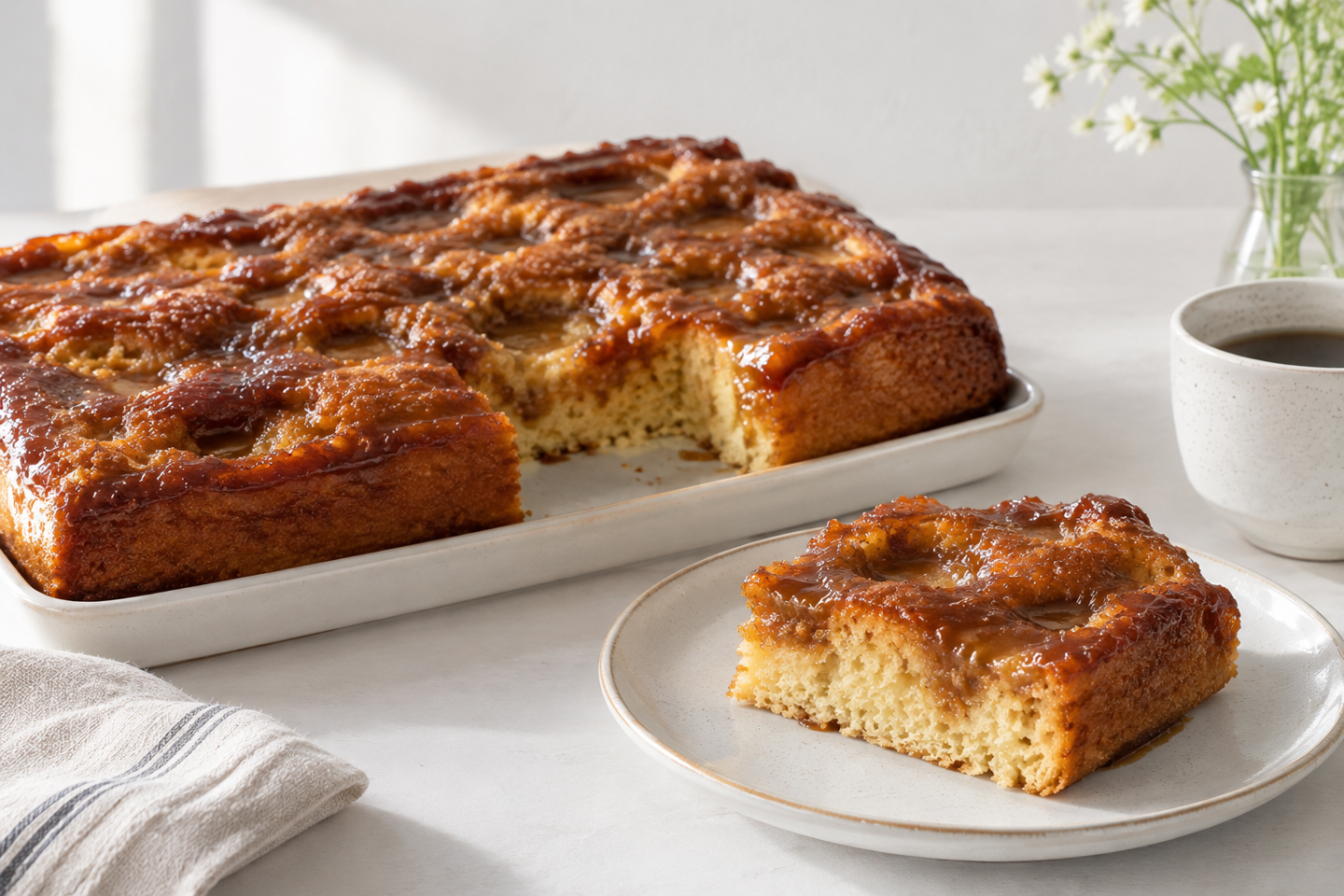
Brunsviger is yeast dough covered in brown sugar and butter, which turns into a sticky, caramelised crust in the oven. Funen calls it its national cake, and once a year, in October, thousands of people line up for a slice. Its day, Brunsvigerens Dag, is today, 8 October. That doesn’t mean you can only find it in bakeries on that one day: brunsviger is baked all year round.
What Is Brunsviger
Yeast dough, dimples pressed in with your fingertips, brown sugar (farin) and butter on top, and about fifteen minutes in a hot oven. What comes out is a soft, light dough with a thick, glossy layer of caramel. It’s eaten with coffee, for breakfast and at birthdays.
German or Funen?
The name most likely comes from the German city of Braunschweig, according to Den Danske Ordbog. Food historian Bi Skaarup, former director of Københavns Bymuseum, argues the cake is of German origin. In his view, a 19th-century German cake called Braunschweiger Dickkuchen is so similar to brunsviger that the two must be the same.
Funen author Anders W. Berthelsen sees it differently. Judging by old newspaper ads, brunsviger developed as a bakers’ product, and the German name is a coincidence: bakers at the time liked to give their cakes German names, such as Hamburg or Hanover cake. Both sides are described in an article on Coop Opskrifter.
The oldest ads found for a cake called brunsviger date from the first half of the 19th century (sources give 1820, 1829 or 1830), and one is from a bakery on Nedergade in Odense. The ads come with no recipe, so we don’t know whether it was the same cake we know today. According to one source, that cake didn’t yet have the layer of sugar and butter on top. The first recipe with brown sugar appears in 1873 in the cookbook Madam Mangors kogebog, but the ingredients were expensive, so hardly anyone made it.
There is also a legend, passed on in Bogen om Brunsvigeren: German brickworkers from Braunschweig brought the cake to a Funen brickworks as early as the 18th century, warming sugar-dusted pieces of bread in the brick kilns. There is no solid evidence for this, so it’s better read as a story than as fact.
How the Cake Became Funen’s
The link to Funen came through the Munkemølle mill in Odense, which sold American flour under the brand AMO, short for Amerikansk Mel i Odense. The bags had recipes printed on them, including one for “Fynsk Brunsviger.” Sources differ on timing: one says around 1919, another that the cake’s popularity only grew in the 1960s.
Today, more brunsviger is baked and eaten on Funen than anywhere else in Denmark. According to the newspaper Nordjyske, each Funen baker buys 100 to 150 kilograms of brown sugar a week, compared with about 25 kilograms on Lolland.
With Cream or Without
Danes don’t agree on one question: does brunsviger get whipped cream? Many North Jutlanders can’t imagine eating it without, while on Funen putting anything on top is considered close to sacrilege. North Jutland is also credited with the futsko, a small version of brunsviger shaped like a little cake with a dip in the middle, filled with the topping.
Brunsvigerens Dag
Brunsvigerens Dag has been held since 2017, always on the last Thursday before the autumn break. According to Nordjyske, it was started by author and radio host Erik Nielsen, who has Funen roots, together with others. His book about the cake came out the same year, and about a third of the first print run sold within a few days. The day’s events across Funen are also described by VisitOdense.
The baking-supplies company CBP says the event at Kold College in Odense is supplied by 43 Funen bakeries, and that around 2,800 people attended there last year. This year the day also expanded to Vejle and Aabenraa. CBP also says Vesterport Bageri in Faaborg bakes about 120 trays that day instead of the usual six to eight.
For Odense’s 1,000th anniversary in 1988, bakers made a giant brunsviger man, according to Danish media. It weighed around two tonnes and covered about 120 square metres, and it was later reportedly entered into the Guinness Book of Records.
Where to Try Brunsviger
You can find brunsviger in bakeries all over Denmark, but Odense is its home. Here is where to try it, according to the local guide Mig og Odense.
In Odense:
- Wendorff, Asylgade 16 and Hjallesevej 130. A thinner base and more topping, with a slightly crunchy crust. Good if you don’t have a big sweet tooth.
- BRØD, Kongensgade 38 and Vestergade 75. A traditional brunsviger on yeast dough.
- Brunsvigerhuset, Stigevej 275 (Stige), Blækhatten 1D (Tornbjerg) and Rugvang 36 (Tarup Center). One of the most popular in Odense, with a good balance of dough and topping.
- Folkebo’s Bageri, Hjallesevej 209. A very thin base and a dark, crunchy topping.
- Baker Boys, Edisonsvej 31. They try new flavours every year.
- Rise’s Brød, Hunderupvej 24, Hjallesevej 52, Odensevej 18A and Kochsgade 178. This year they also have a snail-shaped version.
- Smörbagt, Vestergade 44. Mainly snail-shaped pastries, plus a brunsviger version in caramel sauce. Not a traditional bakery, but worth a try.
In Copenhagen:
- Sinne gas bageri, Ryesgade 63, Østerbro. The local magazine Mig og KBH named it the bakery with the best brunsviger in the city. It’s run by one person, owner Martin Vogelius, and the cake is, as they put it, sweet, sticky and soft.
Brunsviger Recipe in Brief
This is a classic Funen version from a Funen food site, not the original from 1873. For 12 pieces, dissolve 50 g fresh yeast in 2 dl lukewarm milk, add 50 g sugar, half a teaspoon of salt and one egg, then 400 g flour, and knead for about 10 minutes. Work in 100 g soft butter. Let the dough rise for 45 minutes, press it into a 25 x 30 cm pan and let it rise for another 45 minutes.
For the topping, melt 150 g butter, stir in 225 g brown sugar, let it cool and add 1.5 dl kagecreme (Danish pastry cream). The recipe’s author says this is what makes it gooey and sticky. Press dimples into the dough with your fingertips, pour the topping over and bake for 16 to 18 minutes at 210 °C. Let it cool a little before eating, since the topping is very runny.
As the days get shorter and the coffee more necessary, the season of Danish pastries begins. Brunsviger is a lovely way into it, and a good reason to stop by a bakery more often. A warm piece of caramel and a cup of coffee are the best way to welcome winter.