For a few more weeks, at least, in a museum room in Copenhagen. A short walk to the David Collection is all it takes, where an exhibition called “Rørbye & Bindesbøll. The Journey to Constantinople” gathers the drawings of two young Danes who made a trip no Danish artist before them had attempted. It closes on August 23, 2026.
Two Danes, One Detour
It’s 1835, and a young painter named Martinus Rørbye meets an equally young architect, Gottlieb Bindesbøll, in Rome. Both are part of the city’s Danish artist community, gathered loosely around the sculptor Bertel Thorvaldsen. Rather than go their separate ways, they decide to keep traveling together, first across Italy, then to the Greek islands and Athens.
From Athens, a new ship route to Turkey had just opened up, and the two took it, apparently without much planning.
Six Weeks in Constantinople
They reached Smyrna (today’s İzmir) in mid-December 1835, then continued on to Constantinople, the city known today as Istanbul, arriving on December 19. At the time, the Ottoman capital was still largely unfamiliar territory for European artists, nothing like the well-trodden Grand Tour route through Rome and Florence.
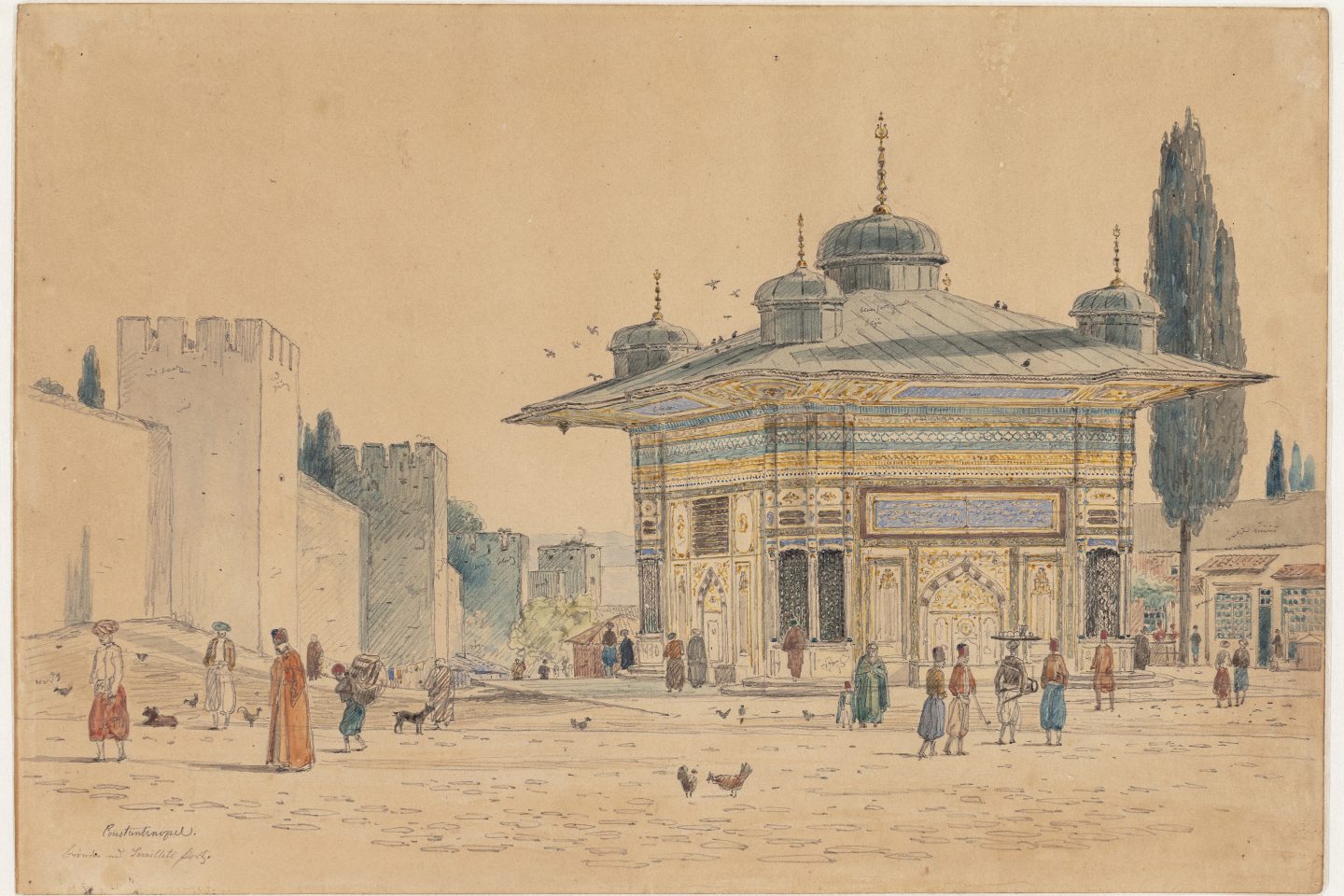
They stayed six weeks. Rørbye sketched the city’s public life: coffeehouses, fountains, the crowds around the great mosques. Bindesbøll, true to his training, focused on architecture, not sweeping views of buildings, but close studies of ornament, color and geometric detail on tiles, windows and facades.
They left Constantinople on February 1, 1836, and neither seems to have gone back.
What Came After
The trip shaped both of their careers, though in different ways. Rørbye became the first Danish painter to visit Greece and Turkey, and the orientalist paintings he produced afterward were well received back home. He kept returning to Constantinople as a subject for years.
Bindesbøll’s version of the influence is less obvious but arguably more lasting. The ornamental vocabulary he picked up during those six weeks, the color schemes, the patterning, the way Ottoman buildings handled repetition and light, shows up later in his best-known work, the Thorvaldsens Museum in Copenhagen. It’s one of the buildings that defined 19th-century Danish architecture, and part of its design traces back, indirectly, to a few weeks spent sketching in Constantinople.
One more detail worth knowing: five years after this trip, Hans Christian Andersen traveled a similar route to Turkey and wrote about it in “A Poet’s Bazaar.”
Why It’s Worth the Trip
What makes this exhibition worth seeing isn’t just the backstory. The sketches on display are essentially the only visual record left of a Constantinople that no longer looks like this. Some of the mosques are still standing. Most of the fountains and street scenes Rørbye drew are long gone.
Admission is free, and the show has gotten strong reviews from Danish critics, including five stars from Kristeligt Dagblad.
After August 23, the drawings go back into storage, and there’s no telling when, or if, they’ll be shown together again.
Plan Your Visit
- Exhibition: Rørbye & Bindesbøll. The Journey to Constantinople
- Dates: February 5 – August 23, 2026
- Location: The David Collection, Kronprinsessegade 30-32, 1306 Copenhagen K
- Admission: Free
- Website: davidmus.dk, exhibition page
- Instagram: @thedavidcollection_
- Facebook: facebook.com/DavidsSamling
- Opening hours: Closed Mondays. Tuesday, Thursday & Friday 10:00–17:00, Wednesday 10:00–21:00, Saturday & Sunday 10:00–17:00