Did you know you can walk into a Danish forest and look into the face of a man who died 2,400 years ago, and that he’ll look like he simply fell asleep? It sounds like a scene from a horror movie, but this is pure archaeology.
For decades, Denmark’s peat bogs kept giving up body after body, so well preserved that the people who found them first reported them to the police as fresh murder victims. Today these bodies are the star attractions of several Danish museums. Here’s who they are, where they were found, and where you can see them in person.
The secret behind their preservation is actually simple: cold, wet, acidic bog water with almost no oxygen stops bacteria from doing their job, so instead of decomposing, the body stays remarkably intact for centuries.
Tollund Man, the most peaceful face in archaeology
Two brothers were cutting peat in Bjældskovdal, near Silkeborg, when on May 6, 1950, they came across a body that looked so fresh they called the police right away, convinced it was a recent murder. It turned out the man had been dead for more than 2,400 years, sometime between 405 and 380 BCE.
He lies curled up, as if sleeping. A leather noose is still around his neck, a sign he was hanged, most likely as part of a ritual sacrifice. Conservation techniques at the time weren’t nearly good enough, so only the original head was preserved. The body on display today is a reconstruction from 1987, built around the original skeleton.
Where to see him: Museum Silkeborg (Hovedgården), Silkeborg Website: museumsilkeborg.dk Instagram: @museum_silkeborg_
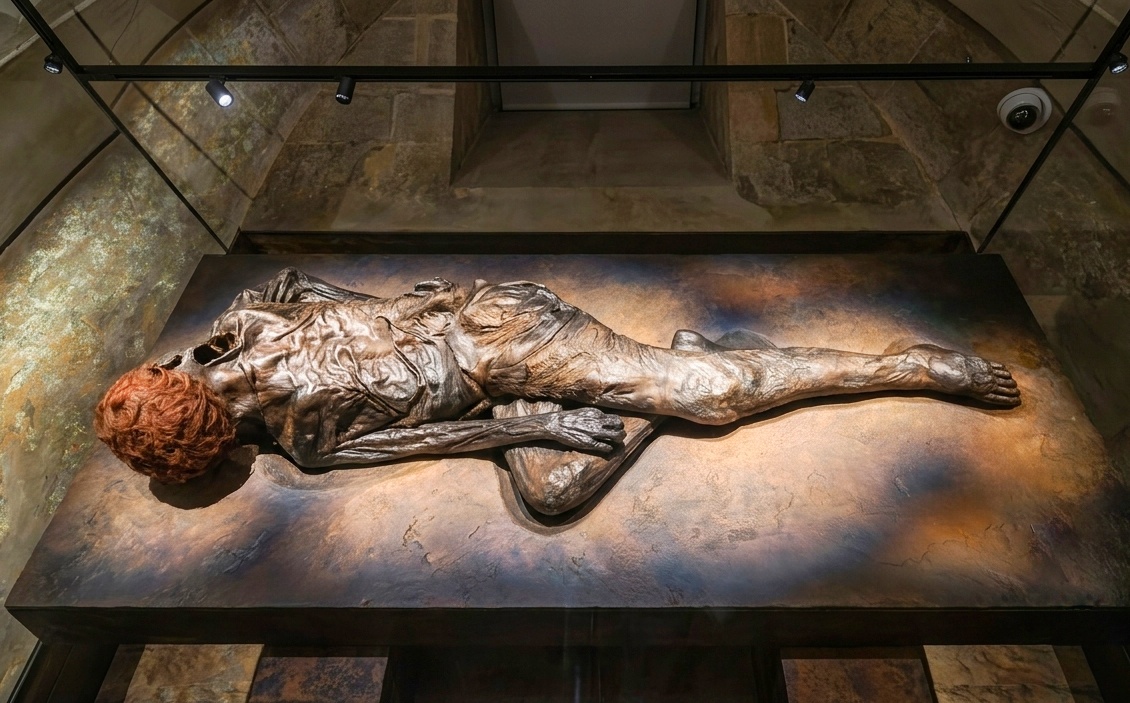
Grauballe Man, the best-preserved body on the planet
Two years later, a worker cutting peat near the village of Grauballe first noticed a tuft of reddish hair on April 26, 1952, and then the rest of the body. He still holds the title of the best-preserved bog body in the world, with visible hair, fingernails, toenails, and even fingerprints.
He lived in the third century BCE. Scientists have even managed to reconstruct his last meal. The cause of death isn’t pretty: his throat had been cut, which points strongly to ritual killing rather than an accidental death.
Where to see him: Moesgaard Museum, Højbjerg near Aarhus Website: moesgaardmuseum.dk Instagram: @moesgaardmuseum
Elling Woman, the braid that survived 2,300 years
Twelve years before Tollund Man, in the same bog, another body was found in 1938. She was named Elling Woman. Her face isn’t as well preserved, but her braid is: 90 centimeters long, expertly plaited and tied in a knot that survived almost 2,300 years. She died around 280 BCE, likely hanged, with a leather noose around her neck, just like her neighbor from the same bog.
Where to see her: Museum Silkeborg, Silkeborg (displayed right next to Tollund Man) Website: museumsilkeborg.dk Instagram: @museum_silkeborg_
Huldremose Woman, an Iron Age closet frozen in time
Found near Ramten in Djursland in 1879. What makes her special isn’t just the body, it’s the clothing: a checked wool skirt, a scarf, and two leather capes, nearly all intact. Thanks to her, scientists have a rare window into how Iron Age people actually dressed. She died in her late forties, which counted as old age at the time, and her arm shows a deep cut inflicted before death.
Where to see her: National Museum of Denmark, Copenhagen Website: en.natmus.dk
Haraldskær Woman, older than the Vikings themselves
Found near Vejle in 1835, one of the oldest discoveries of its kind on record. She was so well preserved that people at the time were convinced she was the legendary Norwegian queen Gunnhild. The story was so convincing that King Frederik VI gifted her an elaborate wooden coffin. Radiocarbon dating later revealed the truth: she died around 490 BCE, centuries before the Vikings even existed. There’s a faint mark around her neck suggesting strangulation, and her stomach contained traces of millet and blackberries.
Where to see her: Kulturmuseet (Vejlemuseerne), Vejle Website: kulturmuseet.dk
Why did they end up in the bog?
This question still puzzles archaeologists. Iron Age bogs weren’t random dumping grounds for bodies. They’re believed to have been sacred sites, a kind of border between the world of the living and the world of the gods. Bodies are often found alongside other offerings: weapons, food, pottery, even cut-off braids of hair. All of it points to complex rituals meant to appease the gods or ensure the fertility of the land.
Whether it was punishment, sacrifice, or some kind of honor, no one knows for certain. And that’s part of why the story still fascinates people.
Worth seeing in person? Absolutely.
This isn’t your average museum visit, it’s a genuine face-to-face encounter with someone who walked this land two thousand years ago. Silkeborg gives you Tollund Man and Elling Woman, Aarhus keeps Grauballe Man, Vejle hides Haraldskær Woman, and Copenhagen has Huldremose Woman and her wardrobe. Wherever you go, the past is closer than you’d think.
Which city would you pick, and which one would you want to meet first?