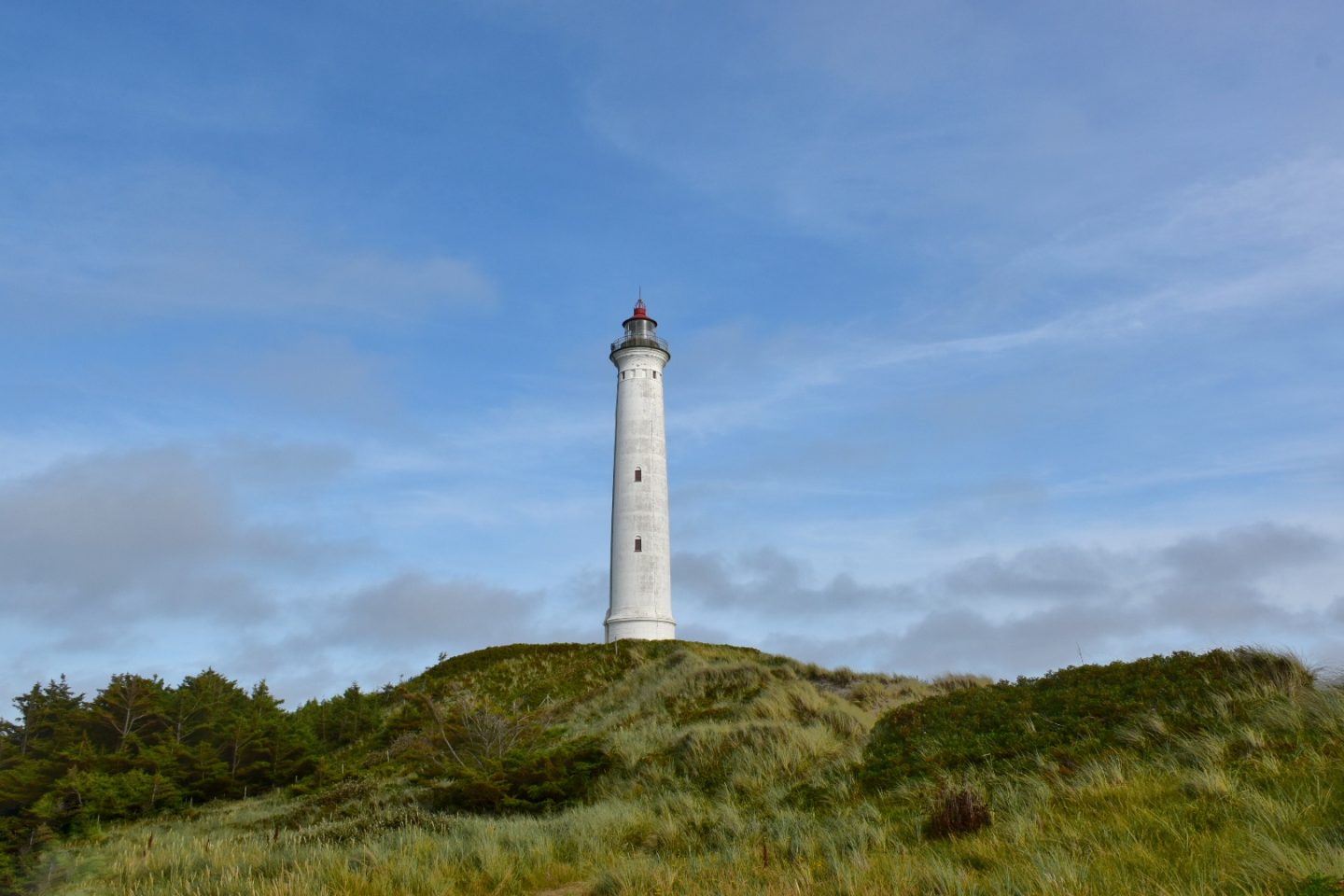
On a narrow strip of sand between the raging North Sea and the calm waters of Ringkøbing Fjord stands a slender white tower. For over a century it has watched the horizon. It never blinks. It’s called Lyngvig Fyr, and its story begins the way every good lighthouse story does: with a tragedy.
The Night the Sea Took Twenty-Four Lives
The Norwegian steamship Avona loses its battle with the sandbanks of Holmsland Klit in 1903. Twenty-four sailors vanish into the waves that night. For decades, the coast between Thyborøn and Hvide Sande had swallowed ships like toys, earning it the nickname Jernkysten, the Iron Coast.
The Avona was the final straw. Denmark’s Lighthouse Authority made a decision: here, where the dunes drop straight into the sea, a light had to stand so the story would never repeat itself.
The Last Tower to Arrive
Architect Aage V. Petersen, employed by the Lighthouse Authority, designed both the tower and the keeper’s house. Construction used 300,000 bricks. People traveled from far away just to watch it rise from the sand. On November 3, 1906, the last major lighthouse on Denmark’s North Sea coast was lit for the first time.
It stands 38 meters tall. But since it sits atop a 17 meter dune, its flame reaches 53 meters above sea level, recognizable at night by its unique signature: a white flash every five seconds.
Above the entrance door, the monogram of King Frederik VIII still remains, a king who reigned for only six years. His mark rarely survives on buildings today. Lyngvig is one of the few that carries it.
Three Men and a Light That Could Never Fail
It took three people to keep the lighthouse running: the keeper, his assistant, and a man responsible for the flame itself. They lived there with their families, surrounded only by the sea, the fjord, and the dunes. Hvide Sande, the nearest town, wasn’t founded until 1931.
The counterweight that turned the light had to be wound by hand every four hours, day and night, without exception. The light could never fail. For every sailor on the horizon, that was a matter of life and death. That remained true until 1965, when the lighthouse was automated. The last keeper didn’t move out until December 2006.
When the Eye Had to Close
The war brought a silence Lyngvig had never known. British airmen used the gap at Hvide Sande, and likely the lighthouse itself, as a landmark over occupied Denmark, so German forces ordered it darkened, along with every other lighthouse in the country. By day, the white tower, even unlit, remained visible.
The occupiers planned to blow it up. The plan was never carried out.
When the eye reopened after the war, it looked out on something new: concrete bunkers where fishing boats once stood. Today, in that same spot, children build sandcastles.
The Fight for the Real Light
In the early 2000s, someone decided to replace Lyngvig’s traditional, swaying yellow light with a steady white sodium lamp. More practical. And completely without soul.
Locals disagreed. They fought for it, and on December 23, 2013, the old yellow eye flickered back to life over the dunes.
A Lighthouse That No Longer Guides Ships, But Still Guides Visitors
In 2010, the Ministry of Environment purchased the lighthouse. A year later, management passed to the Ringkøbing-Skjern Museum. The keeper’s house is now a café and gift shop. Visitors climb 228 steps, through a low, Hobbit-like doorway, up to a platform overlooking the North Sea, the fjord, and the full dune landscape of Holmsland Klit.
Below, children rescue imaginary sailors on a zip line, or crawl through a whale skeleton. Adults drink coffee and watch.
Planning a visit: tickets to climb the lighthouse can be bought on site or booked online in advance, while the grounds themselves, the courtyard, café, and shop, are free to explore. Opening hours change with the season: longer in summer, shorter in winter, with a break around Christmas (December 23 to 25). For exact prices, hours, and all other details, it’s best to check the official website before you go.
Official information and current opening hours: ringkobingfjordmuseer.dk/en/museer/lyngvig-fyr. The lighthouse doesn’t have its own Instagram account; it’s run by the umbrella organization that manages ten museums along Ringkøbing Fjord: @ringkobingfjordmuseer.
The Last Watch
Lyngvig Fyr isn’t special because of its height or its architecture. It’s special because it has, quite literally, been the eye that watched it all: sunken ships, keeper families living in the shadow of their own light, wartime planes and bunkers, and today, tourists building sandcastles where fear of the sea once ruled.
A hundred and twenty years later, the light still shines. One flash, every five seconds. A reminder that on the edge of Denmark, a tower is still standing watch.